Curated at the TU Braunschweig

BRENDA

Unique in quality, depth and coverage of the relevant contents. The most comprehensive information repository on enzymes and enzyme ligand data, curated at the Technical University of Braunschweig and licensed through geneXplain.

What is inside

The Comprehensive Enzyme Information System

What BRENDA is, and who curates it.

BRENDA is the most comprehensive information repository on enzymes and enzyme ligand data. The BRENDA enzyme information system has developed into an elaborate system of enzyme and enzyme-ligand information obtained from different sources, combined with flexible query systems and evaluation tools. BRENDA has been developed and is maintained by the Institute of Biochemistry and Bioinformatics at the Technical University of Braunschweig, Germany. Data on enzyme function are extracted manually from primary literature, and are complemented by text and data mining, data integration, and prediction algorithms.

The curation process has been designed to ensure a maximum of quality, depth and coverage of the contents of this unique database. Formal and consistency checks are done by an elaborate computational pipeline. All enzymes in BRENDA are classified according to the biochemical reaction catalyzed, and are assigned to the corresponding Enzyme Commission (EC) numbers. Reaction kinetics are described in detail. BRENDA’s intuitive user interface support a wide range of queries such as fast full text search, advanced complex queries or searching via sequence or substructure. Browsing the contents is facilitated by a Taxonomic Tree, an Enzyme class, a Genome or an Ontology explorer.
Learn more about BRENDA applications and search functions on YouTube

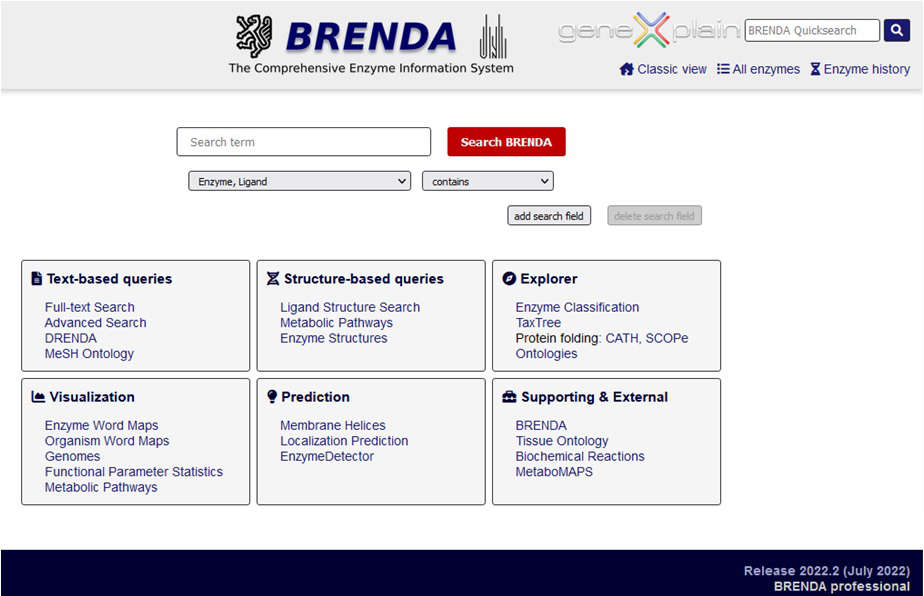
The BRENDA home page: full text search, enzyme classes, and the browsers over taxonomy, genome and ontology.

The BRENDA home page: full text search, enzyme classes, and the browsers over taxonomy, genome and ontology. Tap to enlarge.
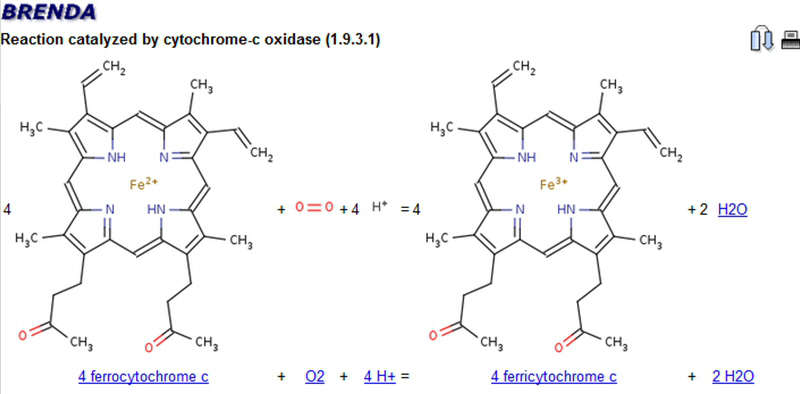
The reaction schema of the cytochrome-c oxidase catalyzed reaction.

The reaction schema of the cytochrome-c oxidase catalyzed reaction. Tap to enlarge.

Structure

Three domains of data.

The data sources of BRENDA comprise three main domains: Text mining data, manual annotation and external databases and ontologies.
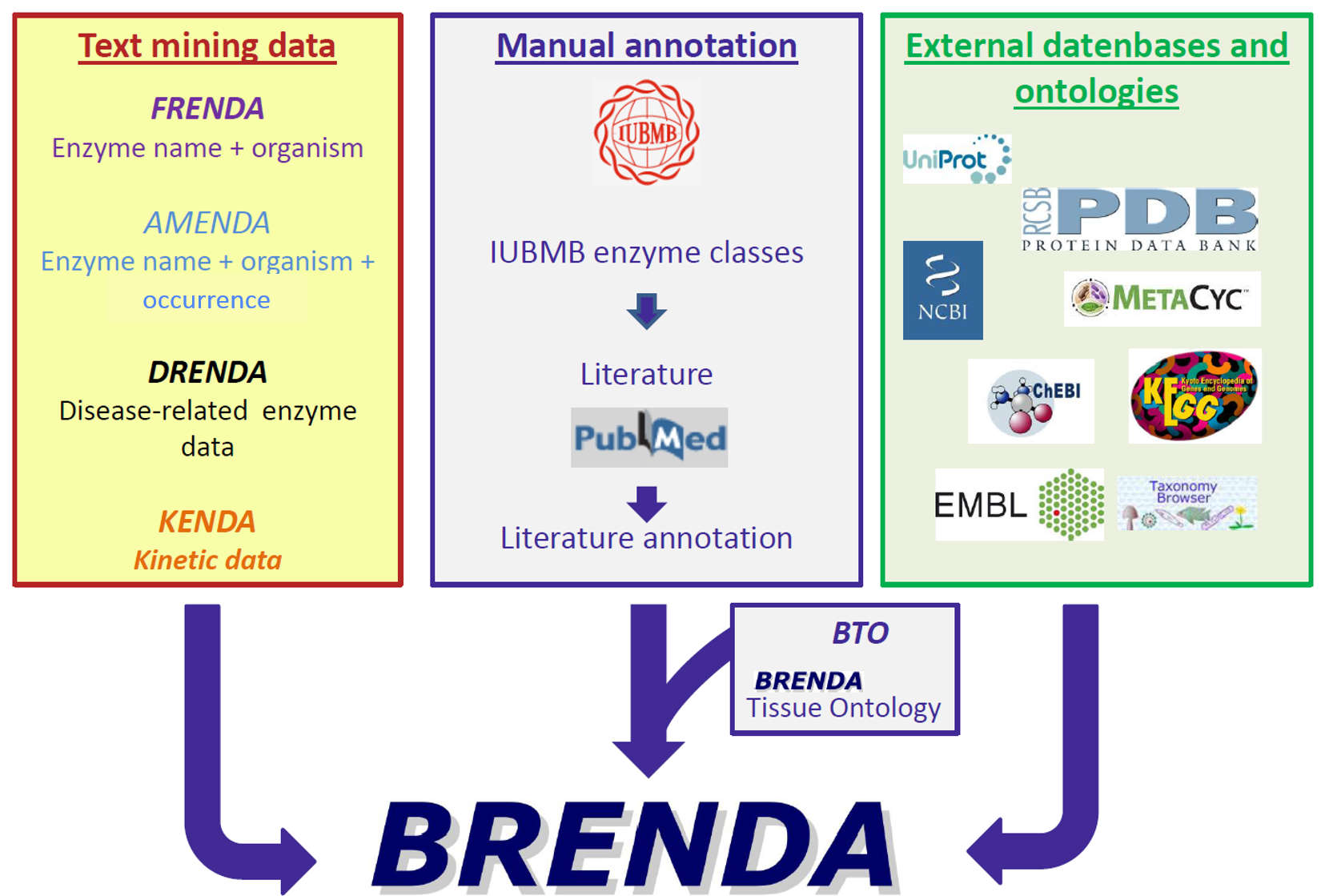
Organization of BRENDA® contents.

Organization of BRENDA® contents. Tap to enlarge.

The supplementary sources FRENDA (enzyme name & organism), AMENDA (enzyme name & organism & occurence), DRENDA (disease-related enzyme data) and KENDA (kinetic data) complement the BRENDA core by text mining data.

The manually annotated core is based on IUBMB enzyme classes and literature from PubMed. Additionally, the BRENDA tissue ontology (BTO) is linked to the manual annotation.

Cross references to several external databases like UniProt, PDB, MetaCyc, ChEBI, KEGG, EMBL, and the Taxonomy Browser of NCBI further expand BRENDA.

Key features

What is in the database.

>3M

Data points in the manually derived core

>77,000

Enzymes annotated

>150,000

Publications annotated from

>30,000

Organisms with molecular data

8,149

EC numbers, January 2021

  • Enzyme and enzyme-ligand information is obtained from different sources, combined with flexible query systems and evaluation tools.
  • The data are acquired by manual extraction from primary literature, text and data mining, data integration, and prediction algorithms.
  • The manually derived core contains >3 million data points about >77,000 enzymes annotated from >150,000 publications.
  • BRENDA comprises molecular data from more than 30,000 organisms.
  • Each entry is linked to its publication source and the organism of origin. The entries are supplemented by information on occurrence, enzyme / disease relationships from text mining, sequences and 3D structures from other databases, and predicted enzyme location and genome annotation.
  • The human anatomy atlas CAVEman is linked to the BRENDA Tissue Ontology terms connecting functional enzyme data with their anatomical location.

Word Maps for enzymes generated from PubMed abstracts highlight application and scientific relevance of enzymes. The EnzymeDetector genome annotation tool and the reaction database BKM-react including reactions from BRENDA, KEGG and MetaCyc.

BRENDA is the most comprehensive information repository on enzymes with 8,149 EC numbers (January 2021). Thereof 7,787 EC numbers are considered active while others are preliminary or retired and just kept for documentary purpose.

  • SBML output
  • Web-services

More detailed BRENDA statistics

PDF

Benefits

What a licence gives you.

  • Access the world’s largest manually curated database on enzyme data (>3 million data points annotated).
  • Experience BRENDA’s intuitive interface, which supports both proteomic beginners and experts in easily retrieving their data of interest.
  • Take advantage of all the cross-referenced other major databases like KEGG, UniProt, MetaCyc, EMBL, NCBI, and more.
  • You may install BRENDA on your local Linux or Windows system.
  • Find at your fingertips essential information from practically all fields of molecular biology, biochemistry, medicine or biotechnology.
Cross-referenced databases

Information downloads

Flyer, tutorials, exercises and the release history.

BRENDA Flyer

PDF

BRENDA Tutorial: Introduction

PDF, 0.6 MB

More BRENDA Tutorials

brenda-enzymes.org

BRENDA Exercises

PDF, 1.7 MB

BRENDA Video

YouTube

BRENDA entry at Wikipedia

wikipedia.org

BRENDA release history

PDF

How to Cite Brenda

The paper to quote.

Placzek S, Schomburg I, Chang A, Jeske L, Ulbrich M, Tillack J, Schomburg D.

BRENDA in 2017: new perspectives and new tools in BRENDA.

Nucleic Acids Res. 45(D1):D380-D388  ·  2017 Jan 4

Recent applications

Find below a selection of recent articles reporting about BRENDA applications.

Singh, P.K., et al.

Exploring RdRp–remdesivir interactions to screen RdRp inhibitors for the management of novel coronavirus 2019-nCoV.

SAR QSAR Environ. Res. 31, 857–867  ·  2020

Khurshid, G., et al.

A cyanobacterial photorespiratory bypass model to enhance photosynthesis by rerouting photorespiratory pathway in C3 plants.

Sci. Rep. 10, 20879  ·  2020

Bartman, C., et al.

Factors influencing the development of visceral metastasis of breast cancer: A retrospective multi-center study.

Breast 31, 66-75  ·  2017

Brunk, E., et al.

Systems biology of the structural proteome.

BMC Syst. Biol. 10, 26  ·  2016

Wei, Y., et al.

Insight into Dominant Cellulolytic Bacteria from Two Biogas Digesters and Their Glycoside Hydrolase Genes.

PLoS One 10, e0129921  ·  2015

Tagore, S., et al.

Analyzing methods for path mining with applications in metabolomics.

Gene 534, 125-138  ·  2014

Mayer, G., et al.

Controlled vocabularies and ontologies in proteomics: Overview, principles and practice.

Biochim. Biophys. Acta 1844, 98-107  ·  2014

Ranjan, S., et al.

Computational approach for enzymes present in Capsicum annuum: A review.

Int. J. Drug Dev. & Res. 5, 88-97  ·  2013

New release

What each release changed.

  • BRENDA comprises now 8331 different enzymes.
  • Design of BRENDA Home has been renewed.
  • 428 Enzyme Classes have been updated.
Data addition & further updates
  • The structure of the database has improved with respect to loading times.
  • BRENDA Tissue Ontology (BTO) has been updated.
Data addition & further updates
  • Gene names are now highlighted by a small DNA symbol in the Synonyms section of enzyme summary pages.
  • BRENDA has been supplemented by a newly classified SARS-Cov-2 enzyme given the BRENDA EC number 3.4.22.B80. Papain-like proteinase 2 EC 3.4.22.B50 and papain-like proteinase 1 EC 3.4.22.B14 are additional enzymes related to SARS-Cov-2 with a provisional EC number provided by BRENDA.
Data addition & further updates
  • Enzymes referring to COVID-19 and SARS-Cov-2, 3.4.17.23 and 3.4.22.69 have been updated.
  • Enzyme summary pages have been reworked – amongst others with respect to loading times.
Data addition & further updates
  • The BRENDA chart of metabolic pathways has been revised again.
Data addition & further updates
  • In the current release, BRENDA comprises 7867 EC numbers allotted to seven EC classes. Of these more than 6,280 are active entries, 523 entries are considered preliminary while others are retired and just kept for documentary purpose.
  • 8,659,739 references have been exploited by manual curation or text mining.
  • Users of BRENDA Online or the default local installation will also notice a revised top of the Enzyme Summary Pages and a rearranged left-hand menu providing a direct glance on the amount of data available.
  • BRENDA Online or the default local installation: Chart of metabolic pathways now shows the names for all metabolic pathways. Denominations will be enlarged if necessary and turn to bold font when you mouse-over. Individual pathways are now displayed as parts of a network
Data addition & further updates
  • Translocases create a new EC class, EC7.
Data addition & further updates
  • The number of EC numbers has increased by 241. Thus, in the current release BRENDA comprises 7,512 EC numbers. Of these about 6,000 are active entries, 509 entries are considered preliminary while others are retired and kept for documentary purpose.
  • For the 2018.2 release 7,482,724 references have been exploited by manual curation or text mining.
  • In addition, the Ligand Structure Search has been enhanced and the Ontology “Chemical entities of biological interest” has been updated.
Updates
  • 479 EC classes have been enhanced by manually curated data
  • Word Maps are now also available for a selection of organisms
Data addition & further updates
  • 176 new enzyme classes have been integrated. Now BRENDA comprises 7,271 EC numbers. 951 EC numbers were updated with new manually annotated references and more than 55,000 new data were added in this process. Especially the classes of transferases and oxidoreductases have been enhanced by adding 524 or 212 organisms, respectively. Additional data retrieved by text mining led to a further increase of data.
  • BRENDA Tissue Ontology (BTO) has been extended by 59 additional terms, further 263 synonyms, and 53 new definitions.
  • 15 new pathways have been added.
  • 2,079,383 amino acid sequences of cellular organisms have been added. BRENDA now comprises 9,250,412 amino acid sequences.
New features & updates of the web interface and BRENDA online, respectively:
  • The Enzyme Summary Page has been revised.
  • Most of the newly added pathways are accessible via Pathway Overview for customers using the web interface.

Price request BRENDA

Fill in this form to request a price for a BRENDA licence.

BRENDA license quote request form

Fill in this form to request a price for BRENDA license

Publications

The BRENDA papers.

Schomburg I., Jeske L., Ulbrich M., Placzek S., Chang A., Schomburg D.

The BRENDA enzyme information system – From a database to an expert system.

J. Biotechnol. 261:194-206  ·  2017

Placzek S., Schomburg I., Chang A., Jeske L., Ulbrich M., Tillack J., Schomburg D.

BRENDA in 2017: new perspectives and new tools in BRENDA.

Nucleic Acids Res. 45:D380-D388  ·  2017

Chang A., Schomburg I., Placzek S., Jeske L., Ulbrich M., Xiao M., Sensen C.W., Schomburg D.

BRENDA in 2015: exciting developments in its 25th year of existence.

Nucleic Acids Res. 43:D439-D446  ·  2015

Schomburg I., Chang A., Placzek S., Söhngen C., Rother M., Lang M., Munaretto C., Ulas S., Stelzer M., Grote A. Scheer M., Schomburg D.

BRENDA in 2013: integrated reactions, kinetic data, enzyme function data, improved disease classification: new options and contents in BRENDA.

Nucleic Acids Res. 41:764-772  ·  2013

Gremse M., Chang A., Schomburg I., Grote A., Scheer M., Ebeling C., Schomburg D.

The BRENDA Tissue Ontology (BTO): the first all-integrating ontology of all organisms for enzyme sources.

Nucleic Acids Res. 39:D507-D513  ·  2011

Barthelmes J., Ebeling C., Chang A., Schomburg I., Schomburg D.

BRENDA, AMENDA and FRENDA: the enzyme information system in 2007.

Nucleic Acids Res. 35:D511-D514  ·  2007

Schomburg I., Chang A., Hofmann O., Ebeling C., Ehrentreich F., Schomburg D.

BRENDA: a resource for enzyme data and metabolic information.

Trends Biochem. Sci. 27:54-56  ·  2002

Schomburg, I., Chang, A., Schomburg, D.

BRENDA, enzyme data and metabolic information.

Nucleic Acids Res. 30:47-49  ·  2002

Schomburg, D., Schomburg, I.

Springer Handbook of Enzymes. 2nd Ed.

Springer, Heidelberg  ·  2001

Schomburg, I., Hofmann, O., Baensch, C., Chang, A., Schomburg, D.

Enzyme data and metabolic information: BRENDA, a resource for research in biology, biochemistry, and medicine.

Gene Funct. Dis. 3-4:109-18  ·  2000

BRENDA licence

License the enzyme data, locally or online.

BRENDA installs on your own Linux or Windows system, or runs online. Tell us which you need and whether the licence is academic or commercial.

Curated at the TU Braunschweig · >3 million data points · academic and commercial licences