
Grounded biological data for AI driven research
TRANSFAC Knowledge Graph integrates 38+ years of manually curated transcriptional regulation, causal signaling, and disease biology, delivered as MySQL tables licensable for AI training.
Curated knowledge to ground AI-driven research
It provides curated, mechanistically connected biological knowledge to ground AI models and support AI-driven research across four key areas.
Drug Discovery & Development
Discover targets, biomarkers, mechanisms, and therapeutic opportunities.
Biotechnology & Synthetic Biology
Understand and engineer gene regulation and biological systems.
Precision & Personalized Medicine
Interpret patient-specific molecular data for stratification and treatment decisions.
Multi-Omics & Disease Mechanism Research
Connect multi-omics data to causal pathways and disease mechanisms.
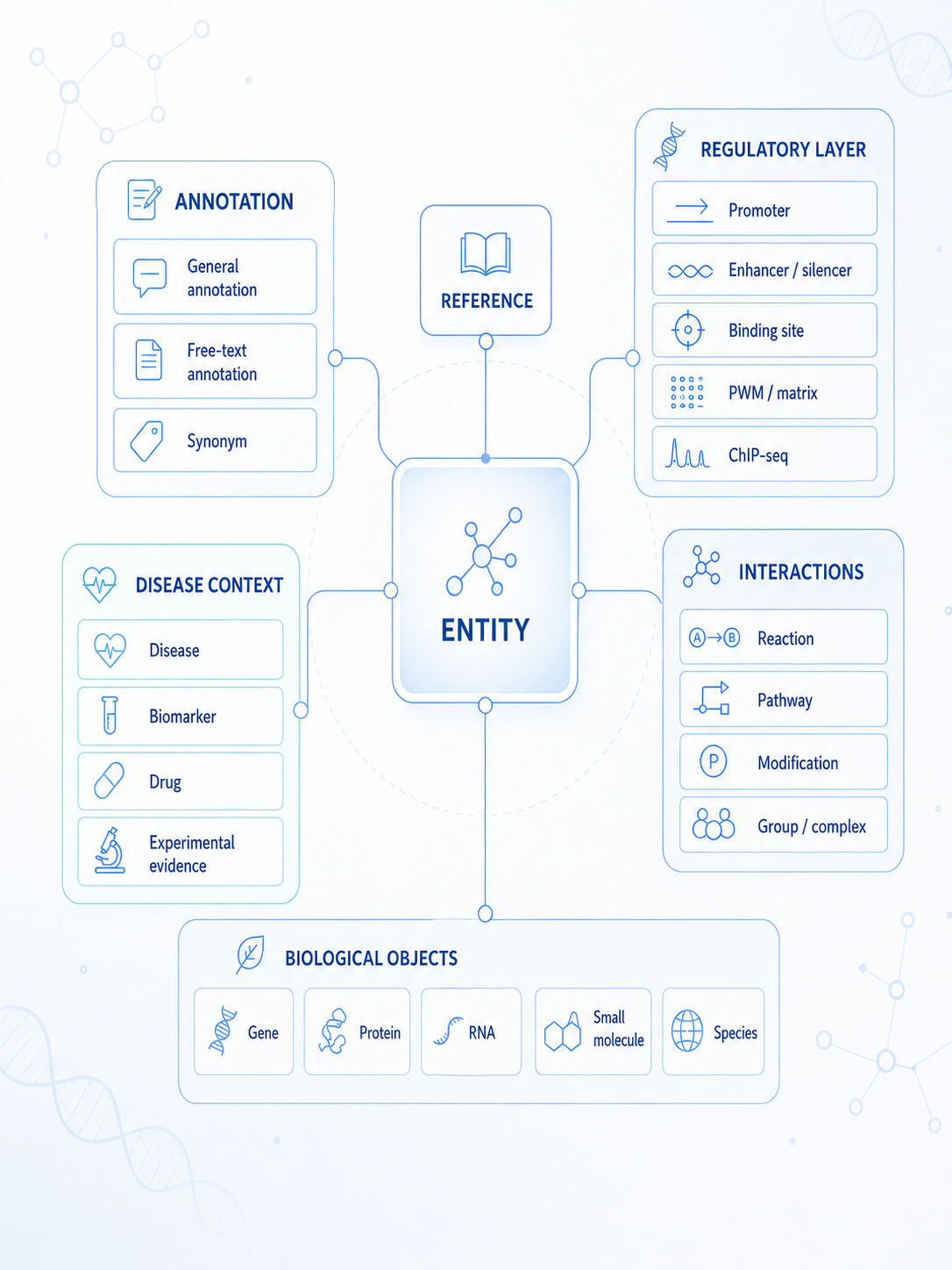
Walk through a simple example to see how the TRANSFAC Knowledge Graph connects transcriptional regulation, causal signaling, and human health insights in one unified view.
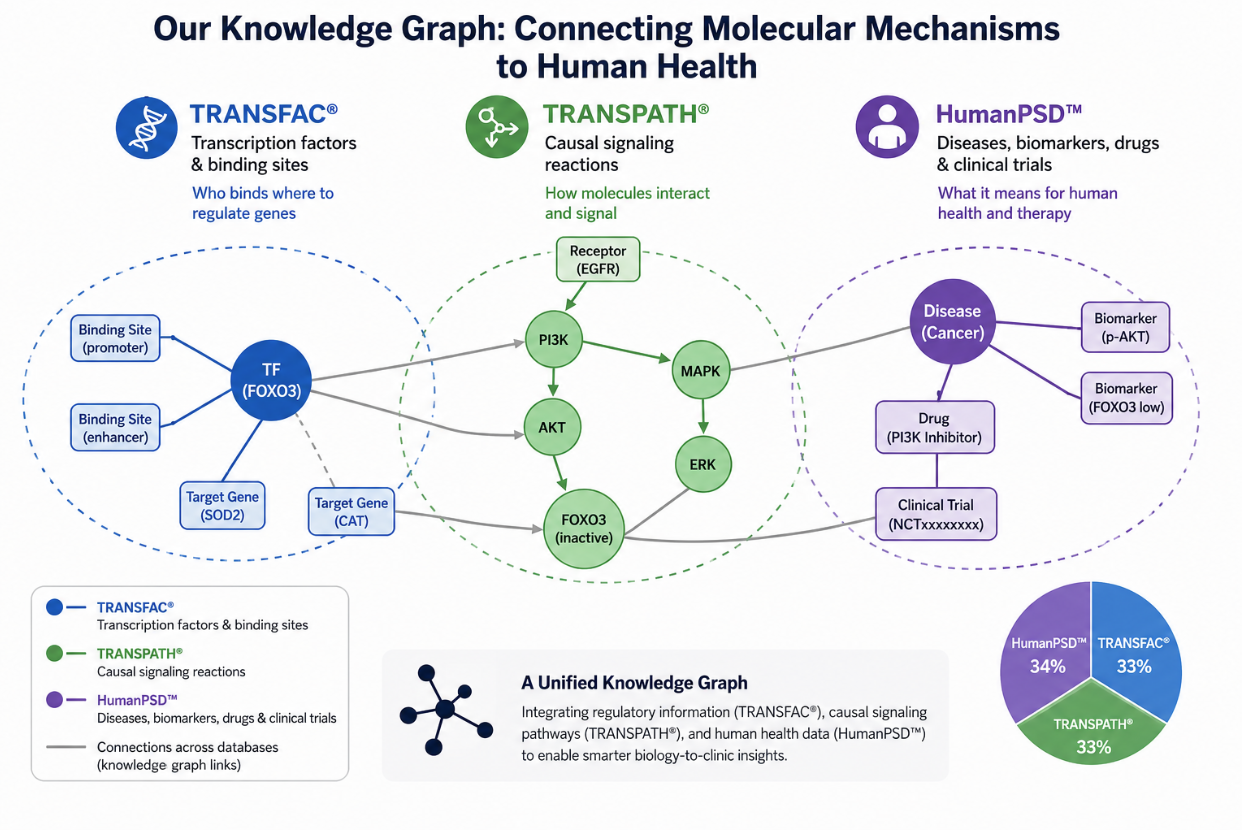
TRANSFAC® for who binds where, TRANSPATH® for how molecules interact and signal, HumanPSD™ for what it means for human health and therapy. Tap to enlarge.
Curated knowledge added to complex research data
TRANSFAC Knowledge Graph strengthens the central stages of the AI-driven research pipeline by adding curated, mechanistically connected biological knowledge to complex research data. It helps integrate and interpret omics, literature, clinical, and other data through established knowledge of transcriptional regulation, causal signalling, disease biology, biomarkers, and drug targets. This provides AI models with more than statistical associations: it adds biological context, causal structure, and traceable evidence. The result is better-grounded model training, more meaningful biological interpretation, stronger target and biomarker discovery, and more reliable decisions across drug discovery, biotechnology, precision medicine, and multi-omics research.
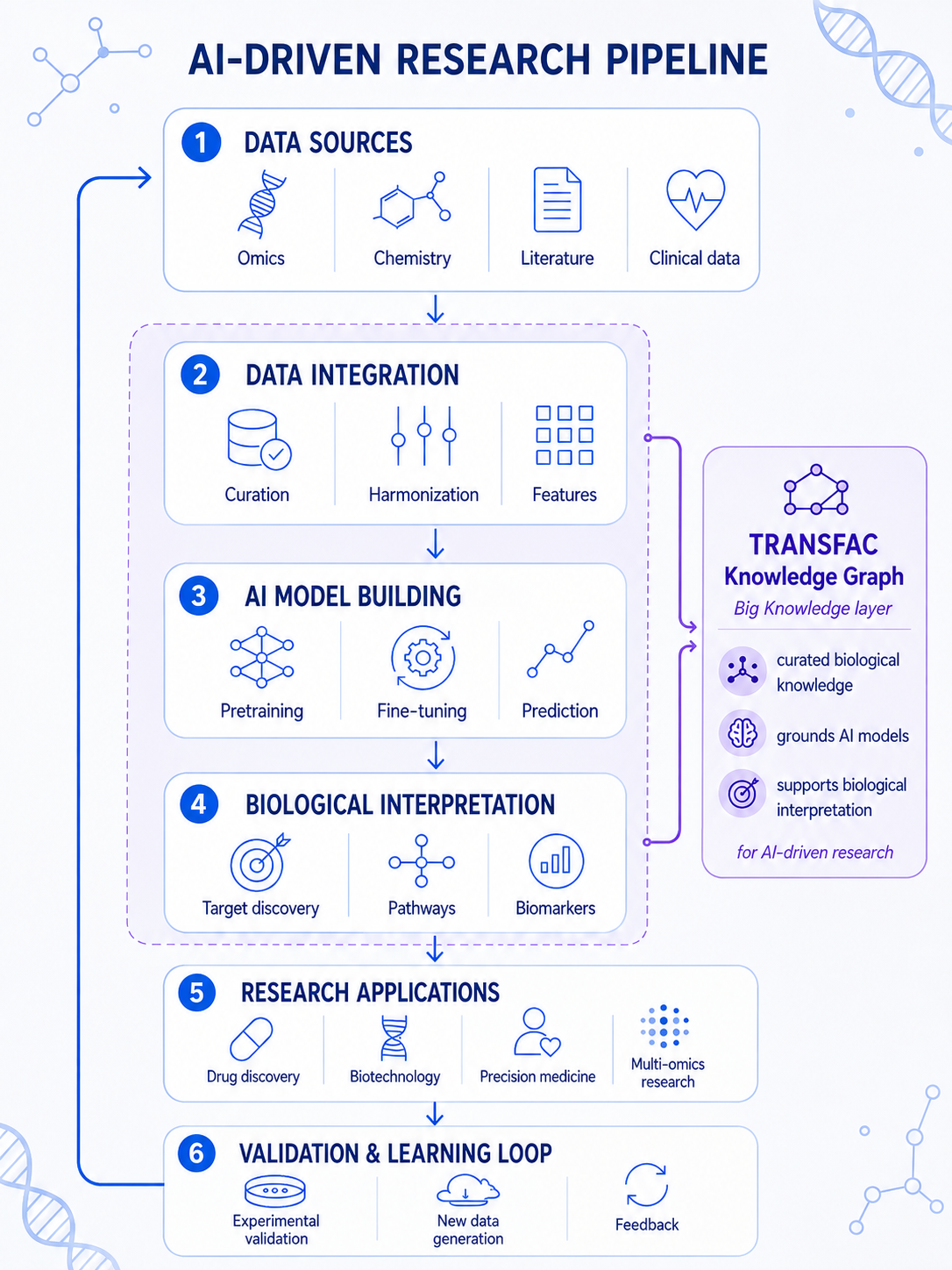
The AI-driven research pipeline, with the TRANSFAC Knowledge Graph as the Big Knowledge layer feeding data integration and biological interpretation. Tap to enlarge.
Public data sets are built for exploration and not for grounding production AI
01
Big data alone
Large language model style training works because text is abundant and homogeneous. Biology is neither. Drug discovery datasets are small relative to the dimensionality of the systems they describe, and the raw omics are noisy. Models trained on raw omics from scratch learn statistical correlations and miss causation, which is why they look strong on benchmarks and fail on a new disease subtype, cell type, or patient cohort. Omics datasets alone give a model the vocabulary of biology without the grammar. Models trained on them can speak fluently and still be wrong.
02
Public knowledge bases
Adding public motif and pathway databases helps. They are real curated knowledge. But they are fragmented, simplified, and missing the cell type and tissue-specific detail that drug discovery actually depends on. It’s the difference between learning a language from a tourist phrasebook and learning it from a proper grammar.
In drug discovery the cost of the wrong or incomplete grammar is measured in years and in capital, not in test set accuracy.
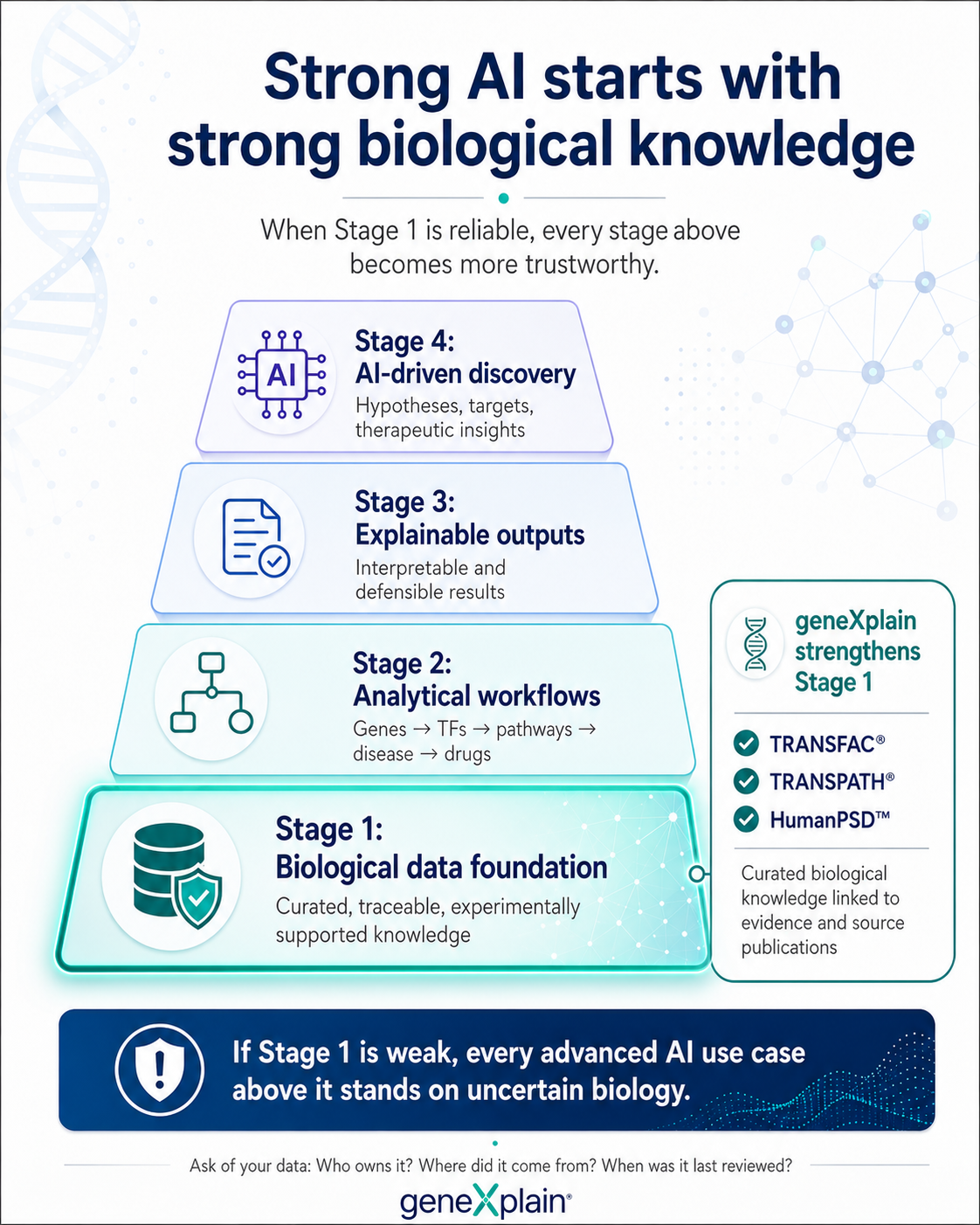
Strong AI starts with strong biological knowledge: when the biological data foundation is reliable, every stage above it becomes more trustworthy. Tap to enlarge.
Big Knowledge.
Robust AI for drug discovery doesn’t come just from more data. It comes from comprehensive, manually curated molecular biology — the kind that took 38 years to build.
Three curated layers. One licensed database.
A licensed biological knowledge graph delivered as MySQL tables, integrating three curated layers built and maintained by the geneXplain team over 38 years. Every entry links to its primary literature. Every reaction has a direction. Every annotation carries an evidence class. Updates ship twice a year.
Layer 01 — TRANSFAC
Transcription factors with their experimentally verified binding sites and the most comprehensive library of DNA motifs — the foundation of regulatory genomics for nearly four decades.
Layer 02 — TRANSPATH
Causal, directional signal transduction reactions across the proteome including modified forms and protein complexes. Not correlation networks — curated reactions with direction, cellular context and source.
Layer 03 — HumanPSD
Diseases, clinical trials, the biggest collection of biomarkers and drug targets with mechanistic annotations and evidence classes — connecting molecular biology to clinical context.
Cross-references resolve to Ensembl, UniProt, PubMed, Reactome, and Human Protein Atlas.
Six numbers that frame what’s inside
50,000+
Transcription factor entries across species
100,000+
Experimentally verified binding sites
1.27M
Causal reactions in TRANSPATH
2,700
Diseases in HumanPSD
400,000+
Biomarker annotations
500+
Disease-specific reconstructed pathways
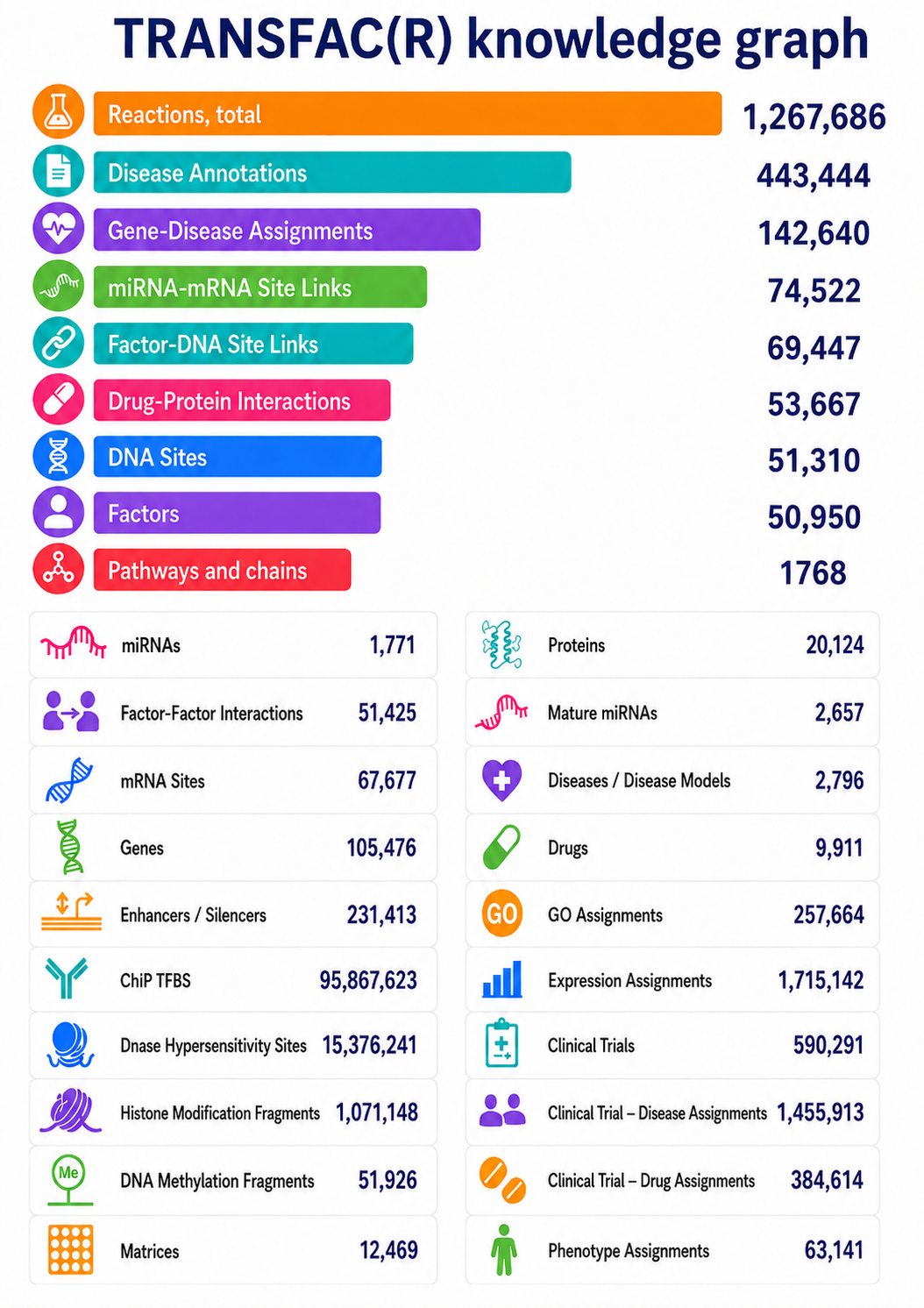
Recent database statistics across the TRANSFAC® Knowledge Graph. Tap to enlarge.
Public databases are not bad, they are insufficient for grounded AI
Public databases often give you fragmented sequence motif collections, mixed genes or protein features, statistical correlations, and aggregated network edges. TRANSFAC Knowledge Graph gives you curated entries traceable to the experiments that produced them, reactions with a direction and cellular context, signaling pathways reconstructed from primary literature, and disease predictive and prognostic biomarkers and drug targets.
TRANSFAC Knowledge Graph advantages
Requirement by requirement, against the public alternatives.
|
Data requirement |
TRANSFAC Knowledge Graph |
Public motif databases |
Public pathway / network databases |
|---|---|---|---|
|
Curated TF binding motif collection |
>11,000 expert curated PWMs derived from experimentally validated TFBS with manually optimized alignments ensuring high biological fidelity |
High quality open motif collections with broad coverage; typically fewer profiles and less harmonization across experiments |
Not applicable |
|
Experimentally verified TF binding sites |
Extensive curated TFBS dataset with links to TFs, genes, species, experimental context, and literature evidence |
Often focused on motif models or ChIP-derived regions; experimental site-level annotation is more limited or heterogeneous |
Not applicable |
|
Composite regulatory elements (TFBS combinations) |
Unique strength
Curated and computationally derived combinations of TF binding sites (composite elements) capturing cooperative and combinatorial regulation — critical for real gene control logic |
Typically represent individual motifs; limited or no systematic modeling of TFBS combinations |
Not applicable |
|
Context-specific motif collections |
Ready-to-use tissue-, cell-type-, and disease-specific motif and TFBS collections reflecting biological context |
Context annotations exist but are not typically delivered as structured, ready-to-use regulatory layers |
Not applicable |
|
Genome-wide TFBS predictions |
Genome-wide TF binding maps across ~1,000 TFs, >300 cell types, and >50 tissues using PWMs and MEALR models |
Genome-wide predictions available but usually less context-aware and less focused on combinatorial regulation |
Not applicable |
|
Enhancers and silencers (context-specific regulatory elements) |
Expert predicted genome-wide enhancers and silencers specific to tissues, cell types, diseases, and phenotypes, based on regulatory grammar and TF combinations |
Enhancer datasets exist (often experimental), but are typically not integrated with TF combinatorial logic or mechanistic regulatory modeling |
Not applicable |
|
Causal signaling reactions |
Large scale collection of curated causal, directional signaling reactions suitable for mechanistic modeling |
Not applicable |
Strong pathway resources exist, but may include mixed evidence types (causal and associative) |
|
Mechanistic molecular detail |
Explicit representation of genes, proteins, isoforms, post-translationally modified forms, and protein complexes, enabling true mechanistic resolution |
Not applicable |
Pathway resources provide structured reactions but often simplify molecular states or aggregate entities |
|
Protein complexes and modified forms |
Detailed modeling of complexes and molecular states within signaling and regulatory processes |
Not applicable |
Present in curated pathways but depth and consistency vary |
|
Protein Genome Map (protein-centric genome annotation) |
New layer
Mapping proteins, their isoforms, modifications, and functional states back onto genomic regulatory regions, bridging genome and proteome in one framework |
Not available |
Not available |
|
Disease-specific pathways |
Expert-reconstructed disease pathways derived from curated biomarkers and causal signaling networks |
Not applicable |
Disease pathways exist but are often generalized or not reconstructed via causal graph approaches |
|
Disease biomarkers |
Structured biomarker knowledge classified by causality, mechanism, prognosis, and drug relevance |
Not applicable |
Disease associations present but not organized as a dedicated mechanistic biomarker layer |
|
Disease similarity maps |
Disease similarity networks based on shared biomarker profiles with expert-weighted evidence types |
Not applicable |
Disease relationships exist but usually not based on structured biomarker similarity modeling |
|
Integration across biological layers |
Unified schema connecting DNA motifs → TFs → regulatory modules → signaling pathways → disease biology → drugs |
Typically focused on regulatory layer only |
Typically focused on pathway/network layer only |
|
Literature traceability |
Each entry linked to primary literature with clear evidence annotation |
References provided but depth varies |
Curated resources provide references; large scale networks may include predicted associations |
|
Data consistency and curation depth |
>38 years of continuous expert curation with consistent schema and harmonized biological representation |
Valuable open resources but variable consistency and depth |
Strong curated resources exist alongside aggregated datasets with mixed evidence types |
|
Best use case |
Mechanistic modeling, AI training, causal inference, and regulatory design |
Motif discovery, benchmarking, exploratory analysis |
Pathway enrichment and general network analysis |
|
Honest limitation |
Commercial licensed dataset optimized for depth, consistency, and mechanistic modeling |
Open and accessible; widely used for benchmarking |
Broad and accessible; may require integration and filtering for mechanistic use |
Who already builds on this
A growing number of AI and biotechnology companies use geneXplain’s curated regulatory, signalling and disease knowledge to strengthen drug discovery workflows — from target and biomarker discovery to mechanism-of-action analysis and therapeutic hypothesis generation.
One example is a leading AI drug discovery company that licensed the full TRANSFAC Knowledge Graph in 2025 for foundation model training and biological grounding.
The database provides its AI models with curated, mechanistically connected knowledge of gene regulation, causal signalling and disease biology.
Beyond commercial AI applications, the knowledge underlying TRANSFAC, TRANSPATH and HumanPSD has also supported peer-reviewed research in master regulator discovery, disease-mechanism reconstruction and drug repurposing.
References1. Myer et al., Gastro Hep Adv (2022).
2. Kel et al., BMC Bioinformatics (2019).
3. Lloyd et al., Disease Models & Mechanisms (2020).
4. Kolmykov et al., Nucleic Acids Research (2020).
Where TRANSFAC Knowledge Graph changes your results
What makes the difference is not the number of motifs or pathways, but the ability to represent how they work together: as composite regulatory elements, context-specific enhancers, and mechanistically resolved molecular states.
01
Foundation model grounding
Models trained on raw omics or aggregated public data tend to learn correlations that do not generalize. Grounding your model in curated regulatory, signaling, and disease knowledge adds causal structure, biological constraints, and traceability to primary literature.
02
Mechanism-based target discovery
Expression-based approaches identify associations. Causal upstream modeling connects disease phenotypes to transcriptional master regulators through signaling pathways, enabling identification of actionable targets rather than correlated markers.
03
Multi-layer integration
Instead of stitching together separate motif, pathway, and disease resources, all layers are already connected in a single schema. Regulators, composite elements, signaling reactions, biomarkers, and diseases are linked consistently, enabling coherent mechanistic interpretation across relevant omics layers.
04
Synthetic regulatory module design
Regulatory design requires more than individual motifs. Using experimentally anchored binding sites, composite regulatory elements, and context-specific enhancer logic enables the design of promoters, enhancers, and regulatory circuits that reflect real biological control mechanisms.
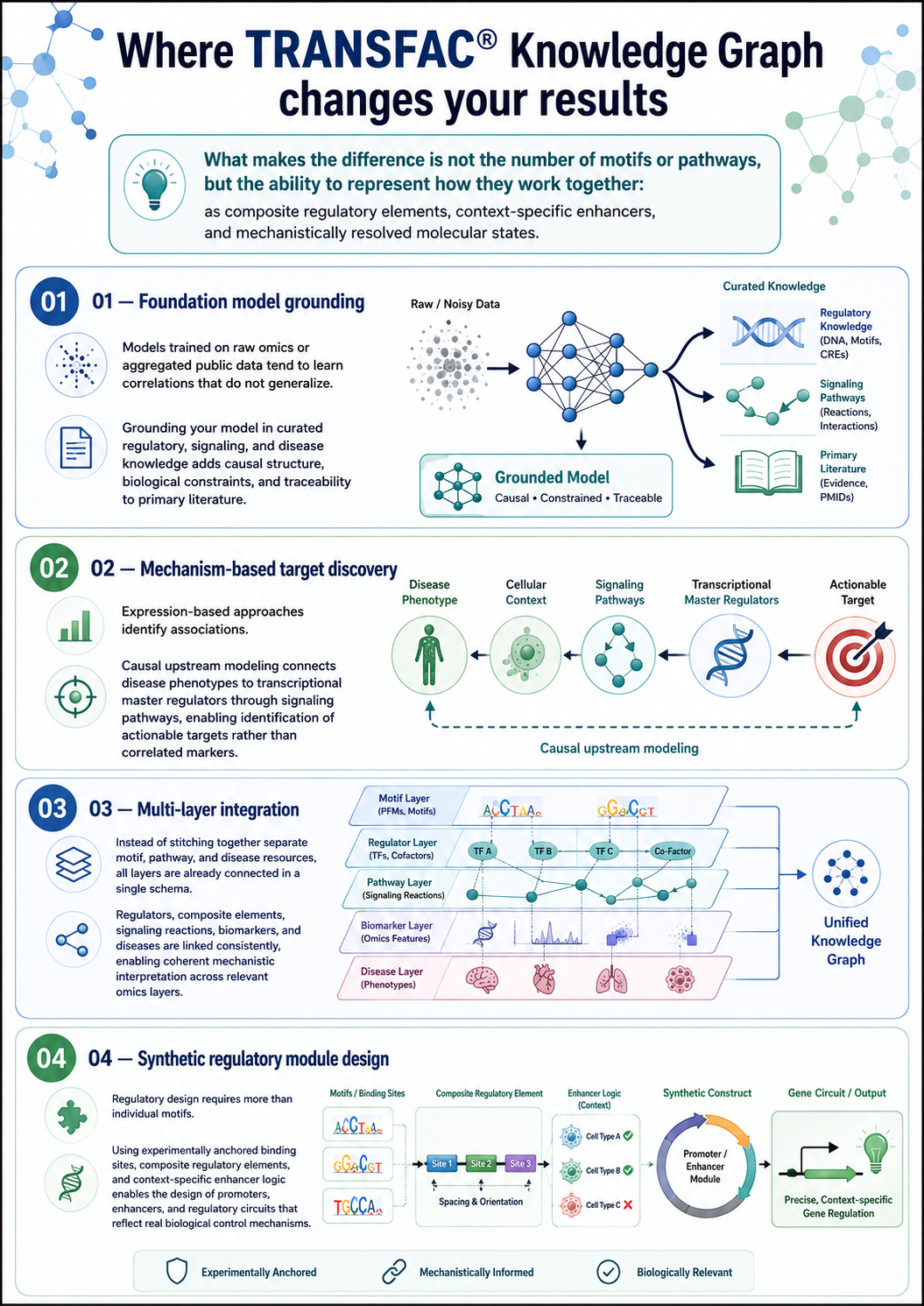
The four places the Knowledge Graph changes a result: grounding, target discovery, multi-layer integration and regulatory design. Tap to enlarge.
Everything that ships with a license
What you license and what you don’t
Not included
Included
Some assets that customers sometimes assume are bundled with TRANSFAC are separate licensed products.
Two license models. Scoped options on request.
Frequently asked questions
Bring your specific question. We’ll tell you whether the database fits.
The database has been developed and curated for 38+ years by the team that originated TRANSFAC. Bring a target class, a disease area, or an evaluation requirement — we’ll help you assess how the data can support your use case.

Prof. Dr. Alexander Kel
CEO & CSO, geneXplain GmbH · Co-author of TRANSFAC and Genome Enhancer
Ground your models on curated biology
License the TRANSFAC Knowledge Graph, or request the schema to see how the three layers connect.