
GX component catalog
Every component the site can be built from, rendered by the same code that builds real pages. FOUND means it already exists on genexplain.com, rewritten in Diana’s palette; ADDED means it is proposed to complete the system.
75 components in 14 groups — 28 found on the site, 47 proposed. Each specimen shows the component as it would appear in a page; the grey line under its name says when to reach for it.
Foundations
Page structure
Content
Data
Navigation
Media and people
Commerce
Articles
Publications and events
Behaviour
Modal · Video · Disclosure · Countdown · Gallery
From the reference systems
Banner · Page header · Code · Glossary term · Progress steps · Task list
Reference
Foundations
The decided values. Everything else is assembled from these — and the reason the live site looks inconsistent is that it currently carries fifteen radii, twenty-five border colours and eighty-four backgrounds.
Text roles
Six roles, no more. The two eyebrow classes must never merge: the section marker is navigation, the sub-marker is a quiet caption inside level-2 structure.
Heading 2 · 36 / 600 / measure 880
Sub-marker · 12 / 1.68 / ink-3Lead paragraph · 17px, measure 760. Carries the section’s promise.
Body · 16px, line height 1.6. The proof for the slow reader.
Caption · 14px italic, ink-3. Footnotes and provenance.
Radius, hairline, surface
Three radii only — 8 for controls, 12 for cards, 16 for card shells. One hairline colour on light, one on dark.
8 controls · 12 cards · 16 shells
rgba(28,117,188,0.14)
rgba(28,117,188,0.18)
#ffffff · #edf5fc tint · #001a2e dark
88 desktop / 72 tablet / 56 mobile, with side gutters
Page structure
The frame of a page: how it opens, how sections are announced, how it closes.
Hero · blue
Deepest of the three tones, and the only one that carries white text. Colours and 48.5° angle are Diana’s own, from the banners in Visual library/A; the light stop is held past the frame so a narrow phone hero cannot pull it into the text. Campaign and landing pages.
Grounded biological data
38 years of manually curated transcriptional regulation, licensed as one database.
Hero · mid
The middle regime: ink text, never white. Its lead is ink rather than ink-2 — ink-2 measures 4.49 on the saturated end and does not pass. Section fronts and hubs.
Release announcement
TRANSFAC, TRANSPATH and HumanPSD databases release 2026.1, geneXplain platform 7.8 and Genome Enhancer 3.8.
Published June 2026 · 12 changes across 5 productsHero · white
The quietest tone, and the only one where every text role works unchanged. Reference and documentation pages read better light — a dark band signals campaign, and makes a changelog feel like a pitch.
Release announcement
TRANSFAC, TRANSPATH and HumanPSD databases release 2026.1, geneXplain platform 7.8 and Genome Enhancer 3.8.
Published June 2026 · 12 changes across 5 productsHero · blue mirrored
Every tone takes side=”left”, which flips gradient and pattern together. This is a trap as much as an option: with a left-aligned heading the busy corner lands under the words, which is the arrangement Diana’s banners avoid. The mirrored set is for centred layouts, and is shown centred here.
Grounded biological data
38 years of manually curated transcriptional regulation, licensed as one database.
Hero · mid mirrored
The middle tone with the pattern on the left. Same ink text rules as its upright twin.
Release announcement
TRANSFAC, TRANSPATH and HumanPSD databases release 2026.1, geneXplain platform 7.8 and Genome Enhancer 3.8.
Published June 2026 · 12 changes across 5 productsHero · white mirrored
The quietest tone mirrored. The pattern is faintest here, so this is the one where the mirrored arrangement costs least.
Release announcement
TRANSFAC, TRANSPATH and HumanPSD databases release 2026.1, geneXplain platform 7.8 and Genome Enhancer 3.8.
Published June 2026 · 12 changes across 5 productsSection header
The fixed opening of every section: eyebrow, H2, lead. Only the H2 is required — pass no eyebrow where the section needs no navigation marker, and no lead where the heading already says everything. Measured reason it exists: across the block markup of 194 live pages there are 35 different heading colours, and the most used one, #9ba0a6 at 222 occurrences, measures 2.63:1 and fails contrast.
Three curated layers. One licensed database.
Everything that ships with a license, and nothing that does not.
The same header with no eyebrow
For a page with one section, or the first section under a hero that already said where the reader is.
Subsection header
The same opening one level down, for splitting a long section. The site already needs it: 625 h3 across 194 pages, three quarters as many as h2 — and not one of them carries a size, 520 carry no colour, so h3 is the one heading nobody ever styled. 26px sits clearly between the 36px section H2 above and the 19px card title inside. The hairline above it does the real work: a heading one step smaller is easy to scroll past, a rule the reader crosses is not. There is deliberately no fourth level. Only 20 of 194 live pages use three heading levels at all, and the h4s that exist say things like “Step 1” and “How to cite PASS:” — items in sequences and lists, already covered by steps, numbered stack, feature grid and spec rows. A fourth level would also land at ~21px, where the card title already is.
With a marker and a lead
The lead drops to 16px here, one step under the section lead, so the two are never mistaken for each other.
Bare form, heading only
Manifest reveal
A dark breather between argument blocks. Names the alternative in one word and moves the reader from ‘saw the problem’ to ‘here comes the answer’. Once per page.
Grounded.
Curated mechanism, traceable to the experiment that produced it — not co-expression that happens to agree.
CTA band
Pages close the way they open, in the same three tones as the heroes and the manifest. Previously two hand-built variants that did not belong to the same family: a dark one with its own radial gradient, and a light one that was a flat tint with neither gradient nor pattern. Padding also differed, 110 against 72, for no stated reason — one number now. Unlike the manifest there is no rule against matching the section above: a manifest interrupts, so sameness kills it, while a CTA concludes, and continuing the surface it concludes from is a legitimate quiet ending.
Interested in licensing our products?
Find out the prices for the products of your interest.
CTA band — white
The quiet close, for reference pages that should not end on a heavy note.
Interested in licensing our products?
Find out the prices for the products of your interest.
Content
The blocks an argument is actually made of. Everything here sits inside a section, under a section header, and none of it is full-bleed.
Value card
One shape, four slots. Counted over the block markup of the 194 live pages: of 170 card-like structures, 63 are title-and-text, 47 carry a list inside and 56 carry a link out — so list and link are slots, not separate components. Equal height comes from putting the surface on the column, not on a rowlayout nested inside it: columnsInnerHeight stretches columns but never their contents, so nested cards read 117/141/165 where these read 165/165/165. The live site fakes it with minHeight, which holds only until some text is longer than the number. The column count is chosen from the item count — four cards go two-by-two rather than three-plus-an-orphan.
One
Short.
Two
A longer body so the heights would differ if the surface sat on a nested rowlayout.
Three
Short.
Four
Short.
Product card
A cross-reference: this thing belongs to product X, go there. Hue on the left edge is the honest home for BRENDA orange and CHEMO green — on this site colour already means which product, which is exactly why status cannot borrow it. No picture and no call to action; it points, it does not sell. The hue says which product; it does not say where the card ends. This card used to carry its own surface, which cost it twice — nested, so the row rendered 173/197/173, and white on white, so the only boundary was a hue measuring 2.37:1 for BRENDA and 2.31:1 for CHEMO against a 3.0 threshold. The surface now comes from the grid and the stripe stays the brand colour.
Package card
A different job from the card above: this one sells. Measured on the live site — the “Request price” call appears on ten pages and 34 times on the pricing page alone, always in the same shape. The head is dark because the screenshots are. The blue field baked into those files takes 57%, 36% and 47% of the three used on the home page, so a light card put a heavy slab above unbounded white text; the card adopts that blue instead of fighting it. Cropping at 21:9 rather than 4:3 drops the field to 33/15/29%. One action, not two — a ghost link beside the button competed with it for the same click.
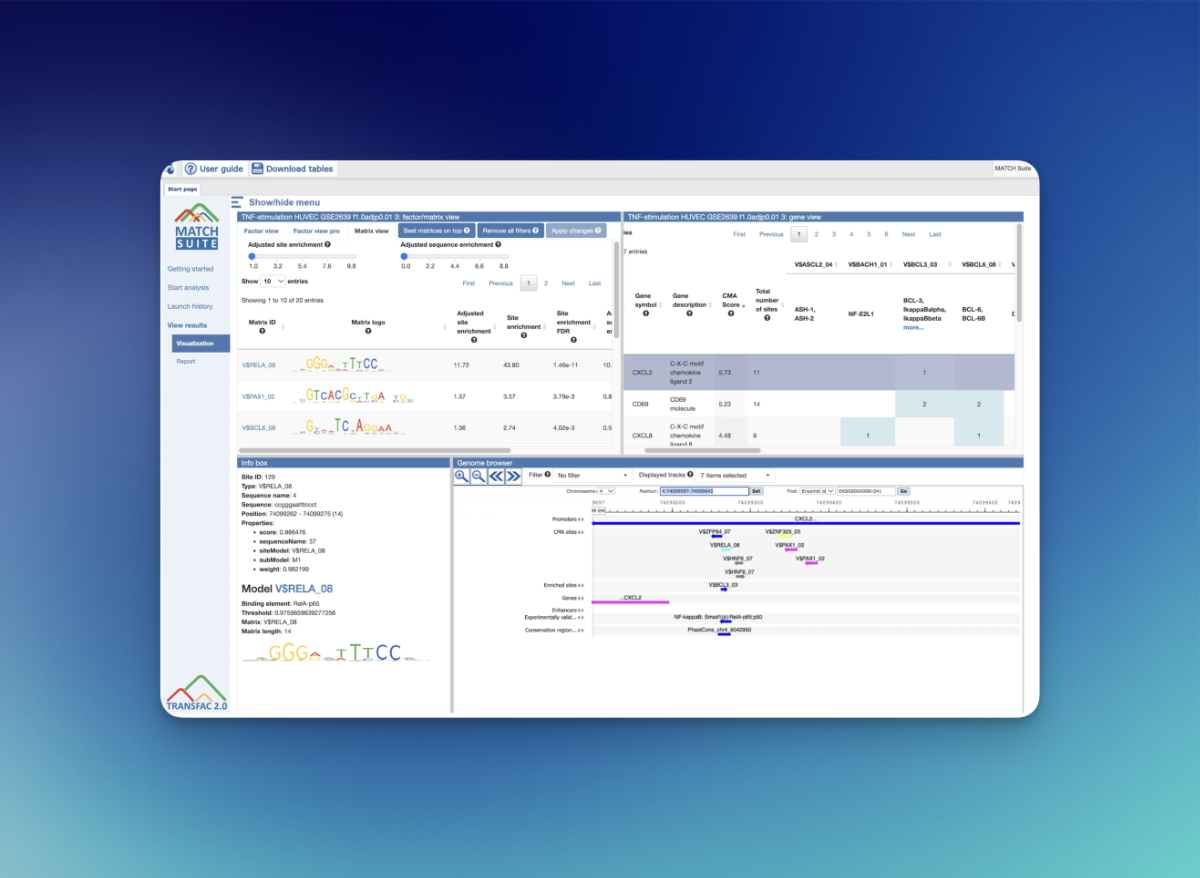
Basic
Discover TF binding sites in promoters and enhancers of your genes.
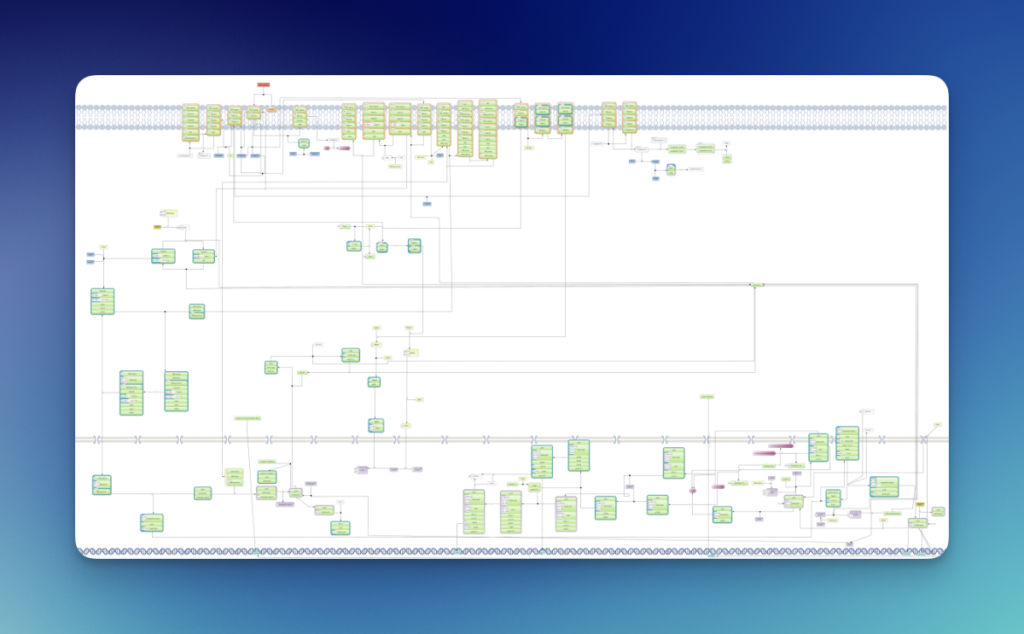
Pathways
Reconstruct the signal transduction network controlling your genes.
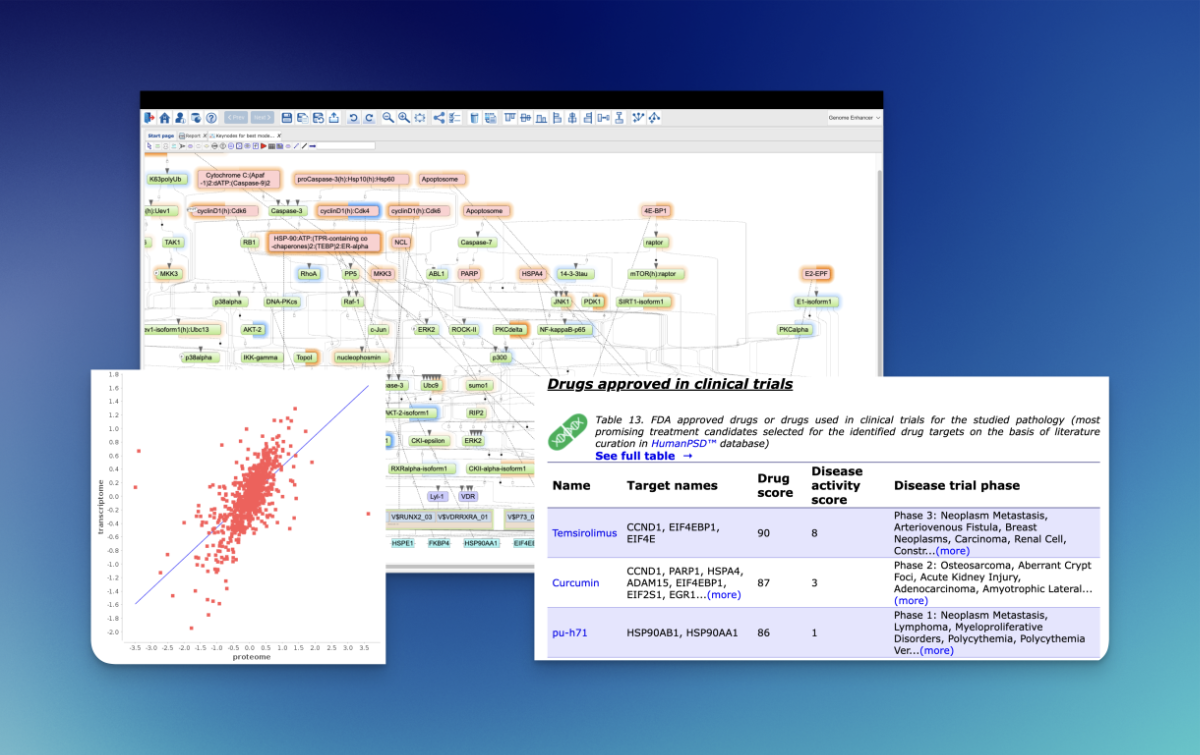
Diseases
Identify drug targets and disease biomarkers from the literature.
Package card, wide
The same card lying down, one to a row, when the screenshot is worth reading rather than glancing at. The picture is a column background, not an image block: a ratio-cropped image is sized by its own aspect and left 16px of card showing under it whenever the words ran taller, while a cover background fills its half at any height. The cost is real — a background carries no alt text, so here the picture is decorative and the words carry the meaning alone.
Basic
Discover TF binding sites in promoters and enhancers of your genes, and compare them against matrices built from the literature.
Pathways
Reconstruct the signal transduction network controlling your genes, then rank the master regulators that drive it.
Card on a dark ground
The same card three times, on each of the three surfaces. A card must never take the fill of the ground under it. Measured after making that mistake in both directions: a tinted card on the tint section rendered 1.00:1 and a white card on the white section rendered 1.00:1 — the same colour, no edge at all. So the fill alternates and callers do not choose it. On the dark ground the border earns its place: the card’s head starts at rgb(15,59,94) where the section passes through rgb(0,59,97), which is 1.01:1, so without a border the top of the card dissolves while its body still reads at 6.81–16.06:1.
Basic
Discover TF binding sites in promoters and enhancers of your genes.
Pathways
Reconstruct the signal transduction network controlling your genes.
Diseases
Identify drug targets and disease biomarkers from the literature.
Numbered stack
An ordered argument where each step earns the next. Numerals stay quiet through size and weight rather than through pale colour, which fails contrast.
01
Public data is built for exploration
It is assembled to be browsed, not depended on by a model in production.
02
The grammar has to be verified
Every reaction carries the experiment it came from, so a claim can be traced.
03
Cost is measured in years
In drug discovery the price of the wrong grammar is not a bad quarter.
Feature grid
Icon, title, one line. For capability lists where a value card is too heavy and a bullet list too flat.

Binding sites
118,987 experimentally verified sites.

Causal reactions
Signal transduction, not correlation.

Clinical evidence
1.4M drug–disease–trial links.

No coding
200+ tools behind one interface.

One click
Raw multi-omics to drug targets.
Quarterly releases
Two database releases every year.
Spec rows
Sparse, text-only inventories. Beats a card grid when items have no icons or numbers, and unlike a card row it does not leave a hole at five items.
TRANSFAC, TRANSPATH and HumanPSD, full release
MATCH Suite, Pathfinder, genome browser
Quarterly updates, curation support, licence review
Prose columns
Long-form text in two measures. Past roughly 90 characters a line gets hard to track back to; splitting is cheaper than shortening approved copy.
The geneXplain platform brings together more than two hundred analysis tools behind a single interface, so a study can move from raw reads to a ranked list of regulators without leaving the environment or writing code.
Every database release is curated by hand rather than imported. That is slower, and it is the reason a claim in TRANSPATH can be traced to the experiment that produced it rather than to a correlation that happened to hold.
Data
Blocks that carry numbers.
Stat grid
Figures that frame a product. Flush cells with partial borders, so every internal edge is exactly 1px and no joint doubles up.
12,469
DNA motifs across all taxa
118,987
Experimentally verified binding sites
>1.2M
Signal transduction reactions
1,631
Pathways
>1.4M
Drug–disease–trial links
802,036
Biomarker annotations
Data table
A real table, for the case the rule allows: ten rows or more and genuinely tabular. On a phone Kadence wraps it in a scroll region with no keyboard access, which axe reports as a serious failure — so prefer spec rows whenever the data can carry it.
|
Database |
Release |
Records |
Updated |
|---|---|---|---|
|
TRANSFAC® |
2026.1 |
50,950 factors |
June 2026 |
|
TRANSPATH® |
2026.1 |
1,267,686 reactions |
June 2026 |
|
HumanPSD™ |
2026.1 |
443,444 annotations |
June 2026 |
|
Protein Genome Map |
2025.2 |
234,192 PTM sites |
December 2025 |
|
TRANSFAC® matrices |
2026.1 |
12,469 motifs |
June 2026 |
|
Enhancers |
2026.1 |
231,413 entries |
June 2026 |
|
Composite elements |
2026.1 |
593 elements |
June 2026 |
|
Pathways |
2026.1 |
1,631 pathways |
June 2026 |
|
Molecules |
2026.1 |
1,110,422 molecules |
June 2026 |
|
Clinical trials |
2026.1 |
1,455,913 links |
June 2026 |
Status
Blocks that say what changed — without borrowing a product’s colour.
Notice
Four tones. Note what is not here: green and orange. Two of the three brand hues name products, so a green success box would read as Chemo Informatics and an orange warning as BRENDA. Status is carried by icon and label instead, with one coloured exception — alert red, which no product owns.
TRANSFAC, TRANSPATH and HumanPSD move to release 2026.1 in this cycle.
Existing workflows run unchanged; results may differ where data was corrected.
Figures in this section are pending confirmation from the product team.
With the new release, results can differ from those produced by earlier versions.
Steps
An ordered process across cards. Built by hand on Solutions; as a component it stops being re-invented on every page.
Low starting fee
You bring the target or disease. We scope the work.
Pay on success
The rest falls due when your targets validate.
Full package
Translational development, scoped case by case.
Media and people
Blocks that carry images, files and faces.
Pull quote
An attributed statement that carries weight. 72/28 so the plate is never narrower than its column, which is what made an earlier version read as a layout bug.
“A model can generate a conclusion. It cannot take responsibility for one.”
Prof. Dr. Alexander Kel
CEO & CSO, co-author of TRANSFAC®

Commerce
Rebuilt from patterns on kinsta.com. Kinsta runs WordPress on a bespoke theme, not Kadence, so nothing could be lifted — these are their arrangements observed and rebuilt in Diana’s palette, which is the only form in which they are any use to us. They fill the gap the site has around licensing and pricing.
Pricing card
Plan, price, what you get, one action. Licence tiers are prose on the site today. A price needs its unit beside it or the number is unreadable, and one card in a row should be visually ahead or the eye has nowhere to land first.
Controlled AI Licence
€24,000
per yearAI & Externalisation
€48,000
per yearDisease area slice
from €9,000 €12,000
Testimonial card
Quote, rating, attribution. Unicode stars rather than an icon font — they inherit colour, need no icon attribute and cannot silently fail. Note the site’s own testimonials are still drafts and hidden, so this ships empty until copy exists.
The curation depth is the reason we license it. Public sets gave us candidates; this gives us mechanism we can defend in review.
★★★★★
Translational research lead
Top-20 pharma
We stopped maintaining our own regulatory graph the quarter after we licensed TRANSFAC. It was never going to be as complete.
★★★★★
Head of computational biology
Biotech, Series C
One engagement replaced five tools and four vendors, and the answer arrived with its provenance attached.
★★★★★
Director of discovery
Mid-cap pharma
Native blocks
Kadence ships blocks this library had been rebuilding by hand. Wrapping the real ones means fewer nodes, editing in the GUI afterwards, and behaviour that generated markup cannot express.
Tabs
Used on the product pages, absent from this library until now. Worth wrapping rather than faking: tab switching is behaviour, and an accordion is the only substitute — but an accordion reads as a list, not as alternatives.
Transcription factors, binding sites and PWMs, plus the geneXplain platform.
Everything in Basic, plus signal transduction and the Pathway Omics Suite.
Everything in Pathways, plus disease, drug and trial annotation.
Articles
Eighteen blog posts exist and the library had nothing behind any of them.
Article header
Posts currently open with a bare heading. Category, date and reading time are what a reader uses to decide whether to start at all.
Why gene signatures fail in another cohort
A signature that survives cross-validation can still collapse on an independent dataset. The reason is usually not the statistics.
Prof. Dr. Alexander Kel · 12 June 2026 · 9 min readPost card
A listing entry with its metadata. The media card has no category, date or author, which is most of what makes a list of posts scannable.
Why gene signatures fail in another cohort
Cross-validation is not external validation, and the gap between them is mechanism.
12 June 2026 · 9 min read
ATAC-seq and the enhancer problem
Open chromatin tells you where to look. It does not tell you what binds.
28 May 2026 · 7 min read
Master regulators in triple-negative breast cancer
Walking upstream from differential expression to the factors that explain it.
14 May 2026 · 11 min read
Publications and events
Two page types the site has and the library did not.
Schedule rows
The webinar page builds its agenda as a 25-row table — exactly the case the table rule says to avoid: two columns, short values, and a scroll region on mobile the keyboard cannot reach.
Welcome and release overview
New in TRANSFAC 2026.1: CAP-SELEX and HT-SELEX matrices
Composite modules on a continuous signal — live demo
TRANSPATH and the Protein Genome Map update
Questions
Behaviour
Blocks that do something when clicked. Each is wrapped rather than imitated, because behaviour cannot be expressed as generated markup — and because Kadence already emits the ARIA that hand-rolled versions get wrong.
Modal
A real popup, and it does work from generated markup. The mechanism is indirection: the dialog sits on the page hidden with an id, and any link pointing at that id opens it. So the trigger is an ordinary anchor and knows nothing about dialogs beyond carrying the class the script binds to. Click the button below.
Video
kadence/videopopup is the click-to-play lightbox the site uses 52 times, and on this install it renders NOTHING — measured 1290×0, zero children, no iframe. It shipped a caption on the Expert page pointing at a hole. It is Pro, so there is no source to read; build/probes/probe_video.py puts three spellings side by side and core/embed is the one that renders and does not depend on a plugin. The specimen is the working one, because a catalog that shows a block drawing nothing is documenting a bug as a component.
Disclosure
One long thing that starts collapsed behind a fade. Lighter than an accordion, which announces itself as a list of choices — use this where there is a single passage most readers will skip.
The Composite Module Analyst finds combinations of transcription factor binding sites whose collective strength correlates with a continuous experimental signal. Each promoter receives a composite score computed by weighted rank correlation, which is robust to outliers. Candidate models are then optimised with a genetic algorithm, where model fitness is correlation strength minus a complexity penalty plus an optional bonus for known factor interactions.
The output is a promoter-level table ranked by composite model score, with genome browser links, per-promoter binding site models, a graphical representation, a scatter plot of signal against score, model statistics, and a JSON representation for programmatic reuse.
From the reference systems
Compared against GOV.UK, Shopify Polaris, Atlassian and GitHub Primer. All four are application systems, so most of what they hold — form inputs, skeletons, drag and drop — has no place here. These appear in three or four of them and answer something this site actually does.
Banner
Page-level strip. Every one of the four has it and this library did not. Distinct from a notice: a notice annotates a passage, a banner speaks about the whole page — ‘this is a draft’, ‘a newer release exists’. The release pages need exactly that, being a cycle stale.
Page header
Atlassian and Primer both carry one; utility pages here open with a bare H1. Trail, title, one line of context, and the actions belonging to the page rather than to any section of it.
Home › Publications › 2026
Publications and patents
Peer-reviewed work by the geneXplain team and by groups licensing TRANSFAC, TRANSPATH and HumanPSD.
214 entries · updated June 2026Code
Identifiers set apart from prose. Atlassian and Primer both carry it, and a bioinformatics site needs it more than either: the 2026.1 notes alone contain factor_pairs_capselex, GSE59612, BDGP6.54 and GRCm39. Set in running text they look like typos.
A new MATCH™ profile set, factor_pairs_capselex, makes the heterodimer matrices searchable in the platform. The demo project ships with GSE59612.
Analyses → Galaxy → Single cell RNA-seq to DEGs → Find DEGs in single cell data
Glossary term
A term that explains itself on hover and on focus. Three of the four reference systems carry a tooltip; Kadence has no such block, so this uses native <abbr title> — no JavaScript, works on keyboard focus, read out by screen readers. On a site where every other noun is an abbreviation it earns its place. Hover the underlined terms.
The database holds PWMs for animals, plants and fungi, together with experimentally verified TFBS and curated PTM annotation.
Task list
Rows that each carry a state. GOV.UK’s task list, and the shape a roadmap or a release checklist wants: what it is on the left, where it stands on the right.
TRANSFAC 2026.1 release notes
TRANSPATH 2026.1 statistics
Genome Enhancer 3.8 feature list
Pathway Omics Suite 3.8 documentation
BioGRID attribution review
Reference
Blocks for pages that document rather than persuade.
References
Numbered citations. A site that publishes claims needs one consistent way to source them; today they are inline italics, or nothing at all.
1. Waleev T. et al. Composite Module Analyst. Nucleic Acids Res. 2006;34:W541–5.
2. Stark C. et al. BioGRID: a general repository for interaction datasets. Nucleic Acids Res. 2006;34:D535–9.
3. Oughtred R. et al. The BioGRID database. Protein Sci. 2021;30:187–200.